How Aggressive Battery Optimization on Mobile Kills Background Web-Socket Connections for Real-Time Dashboards
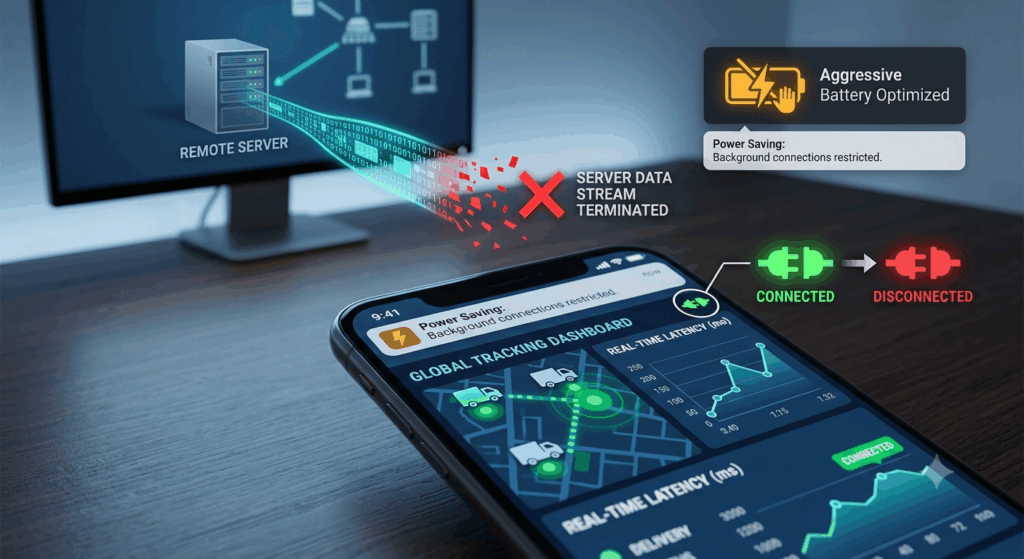
How Aggressive Battery Optimization on Mobile Kills Background Web-Socket Connections for Real-Time Dashboards
For the purpose of tracking real-time business indicators, financial transactions, industrial systems, collaboration platforms, and linked devices, real-time dashboards have become indispensable. In order to receive continuous updates without constantly refreshing the entire page, the majority of these dashboards rely on persistent WebSocket connections. However, aggressive battery optimization measures often disrupt these long-lasting connections on contemporary mobile devices. Although the purpose of these power-saving techniques is to prolong battery life and minimize needless background activity, they frequently stop or suspend network communication that the operating system perceives as inactive. Understanding how battery optimization influences WebSocket behavior lets developers and consumers to increase dashboard dependability while maintaining adequate power efficiency throughout extended mobile usage.
Knowing How WebSocket Connections Work
WebSocket technology creates a persistent communication channel between the browser and the server, in contrast to conventional web requests that initiate and shut individual network sessions. Every time fresh data becomes available, both parties can instantaneously communicate information after the connection has been established. This continuous communication paradigm makes WebSockets excellent for applications requiring quick updates, like monitoring dashboards, message systems, stock market displays, and collaborative editing tools. The operating system must permit network activity to continue even when the application is not constantly getting user input since the connection stays active for extended periods of time. Because of this reliance, WebSockets are especially vulnerable to mobile battery management systems.
Why Battery Optimization Is a Top Priority for Mobile Operating Systems
Through increasingly complex optimization mechanisms, modern smartphones strike a balance between performance, battery life, heat management, and background resource allocation. Applications operating in the background fight for processor time, memory, wireless connectivity, and battery power. Mobile operating systems categorize background operations based on perceived significance and activity levels in order to optimize battery life. Applications showing little apparent involvement are gradually curtailed, while idle network connections may receive decreased scheduling priority or outright shutdown. These changes considerably extend battery life for daily users, but they can unintentionally interrupt apps that depend on constant background communication despite limited visible activity.
How Battery Optimization Breaks Long-Term Connections
There are multiple indirect ways in which battery optimization techniques affect WebSocket dependability. Some operating systems temporarily halt background browser activities after periods of inactivity, preventing the browser from responding to incoming network events. Some restrict processor scheduling, postponing the heartbeat signals necessary to keep WebSocket sessions active. The server ends the session if it does not receive these anticipated keep-alive signals in a predetermined amount of time. Once ended, the browser may not immediately reconnect until the application returns to the foreground. Dashboards appear frozen as a result, despite the server continuing to produce real-time data continuously.
Identifying Broken WebSocket Session Symptoms
Users frequently encounter mild but noticeable symptoms when battery optimization interferes with continuous network communication. While the surrounding interface is still operating normally, dashboard values may cease to update. Notifications appear delayed unless the application is relaunched manually. Live charts freeze despite active server activity, and status indicators may mistakenly represent obsolete system conditions. Some dashboards reconnect automatically after small disruptions, while others require manual page refreshes before obtaining current information again. Because these failures typically do not show any error signals, users sometimes confuse the problem with erratic internet access rather than operating system-imposed background process limitations.
Network Conditions and Their Collective Impact
WebSocket session interruptions are not usually the result of battery optimization. During daily mobility, mobile devices continually switch between cellular networks, wireless access points, and shifting signal strengths. Temporary packet loss, increased network latency, or brief disconnections may coincide with strong background limitations, making recovery more difficult. Additionally, if apps fail to exchange regular keep-alive messages, certain routers terminate idle network sessions after extended periods of inactivity. These combined environmental conditions enhance the chance of unexpected disconnections, particularly during protracted monitoring sessions where user interaction with the dashboard stays limited for long durations.
Developer Strategies for Maintaining Stable Connections
Developers can increase WebSocket reliability by creating applications that accept temporary connection outages instead of assuming uninterrupted communication. Dashboards can quickly regain connections if background limitations are removed thanks to automatic reconnection procedures. In addition to keeping servers from ending idle sessions too soon, periodic heartbeat notifications assist show that connections are still alive. Efficient message handling also lowers superfluous processor usage, decreasing the likelihood of aggressive battery optimization. Instead of relying solely on continuous streaming, applications should synchronize any missing updates after reconnecting. These design techniques provide dashboards that are more robust and able to retain correct data even in difficult mobile working environments.
Power Efficiency and Real-Time Performance in Balance
Maintaining constant connectivity while using batteries responsibly is necessary to achieve dependable real-time communication. Overly cautious communication raises the possibility of connection timeouts, while too frequent network activity can drastically shorten battery life. Adaptive synchronization intervals provide a practical compromise by raising communication frequency during active monitoring while lowering needless background traffic during periods of lesser activity. Developers can also optimize data delivery by sending only incremental updates instead of whole dashboard refreshes whenever possible. Efficient communication reduces processor effort, conserves bandwidth, and decreases the chance of operating system intervention aimed at preserving battery resources.
Building Reliable Mobile Dashboard Experiences
As mobile devices continue prioritizing sophisticated power management, developers must design real-time dashboards with battery optimization in mind rather than treating uninterrupted background processing as guaranteed. Robust reconnection logic, efficient network communication, lightweight background processing, and clever synchronization mechanisms collectively increase program stability across varied hardware platforms. Users also benefit from maintaining updated browsers, avoiding excessive background program loading, and understanding how power-saving features effect long-running web sessions. Developers can produce robust mobile dashboards that continue to provide current information while honoring the battery optimization algorithms that characterize contemporary smartphone operating environments by combining effective WebSocket implementation with careful resource management.