The Impact of Display Refresh Rate Throttling on Web Animation Timings in Prolonged Active Sessions
The Impact of Display Refresh Rate Throttling on Web Animation Timings in Prolonged Active Sessions
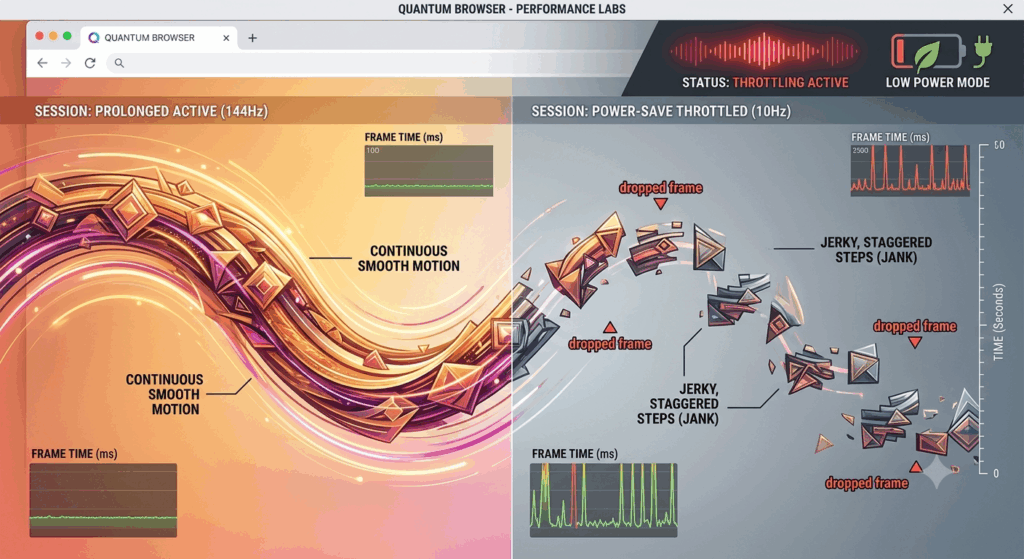
It is becoming increasingly common for modern online apps to rely on fluid animations in order to generate user experiences that are both responsive and engaging across desktop and mobile platforms. High-refresh-rate displays that are capable of operating at 90Hz, 120Hz, or even more have dramatically better visual fluidity. This is because scrolling, transitions, and interactive features appear more natural on these displays than they do on typical 60Hz panels. Active sessions that last for an extended period of time, on the other hand, frequently cause dynamic refresh rate throttling, which is intended to conserve battery life, regulate device temperature, or optimize hardware resources. It is possible for these tweaks to have an effect on the temporal consistency of browser-rendered animations, despite the fact that they improve performance. Users and developers alike can benefit from a better understanding of how modern rendering engines interact with refresh rate throttling, which allows for improved interpretation of animation behavior during extended browsing sessions.
Comprehending the Display Refresh Rates of Contemporary Electronic Devices
Display refresh rate is a term that describes the number of times that the screen changes its image in one second. The use of higher refresh rates gives browsers more possibilities to deliver new animation frames, which ultimately leads to motion that is more fluid and a reduction in the amount of visual lag. Adaptive display technology is an increasingly common feature seen in modern mobile devices such as smartphones, tablets, and laptops. This technology automatically adjusts the refresh rate based on the amount of work being done. In order to reduce the amount of power that is consumed, static material may be displayed at lower refresh rates. On the other hand, interactive interfaces may briefly transition to higher values in order to provide smoother animations. Within the context of day-to-day operation, this dynamic behavior enables devices to strike a compromise between performance and energy economy while simultaneously preserving a responsive user experience.
What the Timing of Browser Animations Is About
By utilizing meticulously synchronized rendering pipelines, modern browsers are able to produce animations. These pipelines coordinate the execution of JavaScript, style calculations, layout modifications, painting, and the final display composition. Many animations on the web are dependent on frame-based rendering methods, which are responsible for synchronizing updates with the refresh cycle of the display. When there is a consistent refresh of the screen, the timing of the animation remains consistent and looks smooth. On the other hand, browsers are dependent on their own internal timing algorithms, which determine the progression of animations independently of the hardware that hosts the display. Because of this separation, animations are able to continue functioning effectively even when refresh rates fluctuate. However, the smoothness that is visible may vary depending on the rendering chances that are available.
The Reasons Behind the Practice of Refresh Rate Throttling During Extended Sessions
For the simple reason that they update the screen substantially more frequently than traditional displays, high-refresh-rate screens require a greater amount of power. By gradually decreasing refresh rates, devices may be able to limit the amount of battery usage and minimize excessive heat generation during extended surfing sessions that involve continuous interaction. Before making a decision regarding whether or not to apply lower refresh rates, thermal management systems check the temperature of the processor, the workload of the graphics, and the state of the battery. Some devices also have the capability to automatically reduce refresh rates when scrolling for an extended period of time stops or when the content that is displayed becomes relatively static. These adaptive adjustments increase the device’s stability over the long run without having the user to intervene directly, while simultaneously maintaining an acceptable level of visual performance.
Influences on the Effortlessness of Web Animation
The visual smoothness of animations is far more affected by the throttling of the refresh rate than the duration of the animations themselves. It is often the case that an animation that is intended to last one second will continue to finish within around the same length of time regardless of the frequency with which the display is refreshed. It is the number of visual frames that occur during that interval that makes the difference. Higher refresh rates provide the impression that movement is especially fluid since they allow for the visibility of more intermediate positions. It is possible that animations will appear significantly less fluid when refresh rates decline during extended sessions, despite the fact that all internal timing will remain exact. Even while the animation logic itself has remained mostly identical, users may occasionally mistake this visual difference as a slower performance even if it is not the case.
Interaction Between the Rendering of the Browser and the Scheduling of the Hardware
In order to provide rendering performance that is both efficient and effective, modern browsers regularly cooperate with the graphics schedulers and display drivers included into operating systems. Hardware scheduling is responsible for determining when rendered frames become available for presentation on the screen, whereas adaptive refresh technologies are responsible for determining the frequency with which those frames are displayed over time. It is possible for browsers to continue creating animation updates in accordance with their own internal timing models even when the refresh rate is throttled; however, the number of rendered frames that ultimately reach the display is reduced. An effective synchronization between the rendering pipelines of the browser and the scheduling of the hardware helps to save the amount of resources that are not essential while maintaining animation consistency. Because to this collaboration, current smartphones are able to maintain a balance between responsiveness and effective battery management even when engaging in lengthy browsing activities.
Taking into consideration the needs of developers for long-running web applications
Developers who are working on interactive web apps should consider designing animations that maintain a consistent visual appearance regardless of the display refresh rate changes. In most cases, the reliability of time-based animation algorithms is superior to that of systems that rely their calculations on set frame counts. The separation of animation progression from individual displayed frames enables motion to maintain its accuracy even when devices dynamically vary the refresh frequency. Additionally, developers should strive to reduce needless rendering complexity. This is due to the fact that high graphical workloads lead to increased processor utilization and may encourage more aggressive refresh rate throttling. In addition to contributing to a smoother visual performance, efficient animation design also helps to reduce the amount of energy consumption and improves the responsiveness of applications over the long run.
Achieving Consistent Animations Through the Optimization of Device Performance
Users have the ability to increase animation consistency throughout extended sessions by ensuring that the device is operating in a healthy manner. By shutting down superfluous background applications, you can lower the amount of competition for the processor, which in turn gives browsers more access to the resources that are available on the system. A browser’s ability to access rendering improvements and performance optimizations brought by subsequent software releases is dependent on the browser’s ability to consistently receive updates. There is a correlation between adequate device cooling and the delay of thermal throttling, which might indirectly contribute to decreased refresh rates. Keeping the battery at a sufficient level can further reduce the aggressive power-saving behavior that certain devices exhibit. These practical maintenance practices, when combined, produce an environment that is more stable for demanding web applications that rely significantly on continual visual animations.
Trends to Watch for in the Field of Adaptive Display Technologies
This evolution of adaptive display solutions is occurring along with the development of browser rendering engines and contemporary graphics hardware. It is anticipated that future devices will be able to provide more sophisticated refresh rate control, which will be able to respond more precisely to the requirements of specific applications rather than to general usage patterns. If browsers, operating systems, graphics processors, and display controllers are able to communicate more effectively with one another, it may be possible to achieve smoother transitions between refresh levels without causing perceptible changes to the visual experience. It will become increasingly critical to have good synchronization between animation engines and adaptive display hardware as online applications continue to become more interactive and visually sophisticated. When developers have a better understanding of the relationship between refresh rate throttling and browser animation timing, they are better able to create online experiences that are durable. This also enables users to enjoy consistent performance across extended browsing sessions on a wide variety of modern devices.