How High-Altitude Platform Systems (HAPS) Are Being Deployed for Rapid Disaster-Recovery Network Connectivity

How High-Altitude Platform Systems (HAPS) Are Being Deployed for Rapid Disaster-Recovery Network Connectivity
When earthquakes, floods, cyclones and wildfires occur, communication networks are often the first thing to go down. Cell towers go dark, fiber routes are cut, backup generators run out of fuel, precisely when millions of people need to reach out to relatives, ask for help and get official warnings. Ground-based repairs to fix the service might take days or weeks, especially if roads are blocked and technicians can not reach the sites of damage. High Altitude Platform Systems, or HAPS, provide an alternative. These solar-powered aircraft, balloons and airships fly in the stratosphere around twenty kilometers above the earth, and can act as floating cell towers to cover large areas. Telecom carriers, aerospace developers and emergency management authorities are already testing how HAPS can provide speedy, flexible connectivity in crisis situations. This article discusses how HAPS work, how they are employed in the aftermath of disasters and what barriers still exist to widespread deployment.
Why Faster Network Recovery is Essential for Disaster Recovery
Communication networks are the nerve system of any emergency response, and their failure in the first hours of a crisis can multiply the human cost. Cell sites lose power when their batteries run out, while landslides, floodwater and fallen trees cut the fiber and microwave links that connect towers to the core network. Even undamaged sites become useless when their backhaul vanishes, isolating entire districts. If survivors can’t contact for help, families can’t check on each other’s welfare, and authorities lose the real-time information they need to send rescue crews and supplies. Traditional restoration techniques such as mobile cell sites on trucks and portable generators require roads that are passable, fuel that is available, and staff that are trained – all of which are in rare supply after a significant incident. The first seventy-two hours are widely recognized as the most essential window for rescue operations, which drives an increasing demand for connectivity technologies that can be swiftly engaged and from a safe distance.
What Are High Altitude Platform Systems and How Do They Work
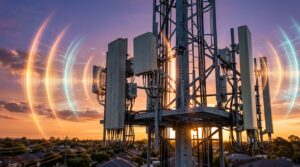
High-Altitude Platform Systems (HAPS) are unmanned aircraft, balloons or airships flying in the stratosphere at an altitude of about eighteen to twenty-five kilometers, well above commercial aviation traffic and most weather. At that altitude in many areas the winds are rather light and there is plenty of sunlight so designs that use solar power can stay aloft for a long time. Very big fixed wing aircraft carry light weight solar panels that charge batteries during the day and power the platform during the nite. Balloons and airships use buoyancy and rely on little propulsion or altitude control techniques to stay in proximity to a target area, a capacity known as station maintaining. Each platform has a communications payload, which may comprise a cellular base station, directional antennas and relay equipment. A HAPS is essentially a tower in the sky providing line-of-sight coverage over terrain that would otherwise require multiple ground locations.
Benefits of Coverage over Land-based and Satellite Options
The big attractiveness of HAPS for disaster recovery is the large coverage footprint and flexible placement. A single platform may cover a circular area with a radius of 50 km or more, which can replace dozens of damaged ground towers in the short term. A platform in the stratosphere is significantly closer to customers than geostationary satellites, therefore the signal delay is much smaller and regular handsets can connect using less power. Unlike low Earth orbit constellations that zip over the damaged region, a HAPS stays over the impacted region, making handovers easier and giving a defined community uninterrupted service. Above the clutter of cities, trees and hills, the platform’s signal can more readily reach valleys and rural towns. HAPS also avoids the high cost and long lead time of launching dedicated rockets, making them ideal for regional and repeated use.
Disaster Management Rapid Response Models
The deployment models depend on the type of platform, but the common goal is to reduce the time between declaring a catastrophe and restoring service. Balloons can be released from an open field within hours and then directed to the target zone by tapping into distinct stratospheric wind layers. Solar aircraft usually begin from a prepared runway, climb slowly over hours and then circle in a holding pattern over the damaged area. Some governments and operators are investigating pre-positioned platforms at regional hubs, to allow staff to respond without substantial transport delays. Each platform is connected to the larger network by a terrestrial gateway, which might be a mobile terminal on a truck, a transportable satellite station or a surviving fiber point at the perimeter of the disaster zone. After the emergency, the platform can be collected, examined, renovated and reused for the next event, which boosts long-term value.
Linking Phones, Responders, and Critical Services
Once in the air, a HAPS can provide the essential services most needed by survivors and responders. Voice conversations and text messaging work on regular cell phones, with no special equipment needed, which is important as most people will not have access to specialized devices after a disaster. Emergency officials can send public warnings, evacuation instructions and shelter places to all phones inside the coverage region. Responders get data connectivity for mapping tools, drone video feeds, patient records and logistics coordination. Priority access settings can also reserve bandwidth for police, firefighters and medical personnel. The technology can be used as a backhaul for community internet at temporary hotspots in humanitarian camps and hospitals. The same link can also carry data from environmental sensors such as river gages and seismic monitors, providing coordinators a better sense of the ongoing threats such as earthquakes, floodwater on the rise or fire spreading.
Interoperability with 5G Standards and Legacy Mobile Networks
For HAPS to be useful in an emergency they have to integrate smoothly with the networks people already use. The global mobile standards now include non-terrestrial network characteristics that specify how base stations on aerial and space platforms link to the core network, handle mobility and facilitate emergency calling. Some mobile frequency bands have also been allocated by international spectrum regulators to high-altitude base stations, offering operators a legal means of serving handsets directly. When a platform is an extension of a commercial network, subscribers can be instantly connected, and roaming agreements enable customers of various operators to share the same temporary coverage. Network slicing and priority can safeguard traffic for public safety agencies from spikes in demand in today’s core networks. Reliable backhaul is still key, therefore many configurations couple the platform with optical, microwave or satellite links that transmit traffic down to the ground gateway.
Technical, regulatory and cost challenges
Despite promising experiments, HAPS face substantial technological, regulatory and financial obstacles. Stratospheric winds are seasonal and geographical, and platforms need to be able to carry enough energy to stay in position or return safely if conditions worsen. The energy density of the batteries limits the weight of the payload an airplane can carry which limits the size of the antenna and the number of users serviced. High altitude flying necessitates collaboration with aviation authorities, while cross-border operations introduce further concerns about airspace rights and spectrum licensing. Safety certification, insurance and procedures for emergency landings are still being worked out in many nations. Another problem is the costs, as it is difficult to justify the expense of a platform that is utilized very periodically for calamities. Consequently, several developers have adopted dual-use models, providing routine rural broadband or monitoring services, but holding back capacity for crisis response.
Future of HAPS: Resilient Disaster Connectivity
As materials science, energy storage, and aircraft engineering develop, the future for HAPS in disaster recovery is brightening. Concepts of lighter solar cells, more capacity batteries and hydrogen fuel cells promise longer endurance and heavier payloads, which would enable larger antennas and more capacity per platform. Connectivity is increasingly being viewed by emergency planners as a layered system, with HAPS working with low Earth orbit satellites, portable towers, drones and community radio, each layer addressing the shortcomings of the others. Ongoing exercises, pre-agreed spectrum permits and standardized protocols among neighboring countries might drastically reduce activation time. As climate-related disasters strike more frequently and more severely, governments are likely to invest in the tools that restore communications in hours rather than days. If these efforts work, HAPS may become a normal part of national resilience strategies, helping ensuring that no community is left without a connection when it needs one most.