How Sub-6GHz C-Band Spectrum Reallocation Affects Fixed Wireless Access (FWA) Broadband Performance in Suburban Markets
How Sub-6GHz C-Band Spectrum Reallocation Affects Fixed Wireless Access (FWA) Broadband Performance in Suburban Markets
Spectrum legislation has played a large role in the rapid evolution of fixed wireless access from a niche solution for rural areas to a mainstream broadband alternative in suburban neighborhoods. The reallocation of mid-band frequencies, particularly the C-band spectrum in the U.S. between around 3.7 and 3.98 gigahertz and analogous blocks elsewhere, has provided mobile operators with a potent new weapon to provide home internet over the air. Low-band spectrum travels far but doesn’t carry much data, millimeter wave spectrum carries speed but suffers with distance. The capacity coverage trade-off is well suited for C-band. Such a shift is creating actual competitive pressure on suburban homes that have just one or two wired broadband options. But the advantages are not universal. Performance is affected by network density, device quality, clearing timelines and how much carriers balance residential internet against mobile traffic. In this study we explore the impact of C-band reallocation on FWA performance, reliability and customer experience in suburban areas.
What is C-Band Spectrum Reallocation and Why Does it Matter?
C-band reallocation is the process of relocating incumbent users, notably satellite operators that provided television and radio content to cable headends, out of portion of the 3.7 to 4.2 gigahertz range so the spectrum can be licensed for terrestrial wireless broadband. In the United States, regulators auctioned off much of this band and mandated a phased clearance process, squeezing satellite services into the upper part and adding a guard band to protect them from interference. Other areas are working toward similar aims with adjacent frequencies around 3.3 to 3.8 gigahertz. This creates a large continuous block of mid-band spectrum operators can use for 5G networks. Contiguous channels of 100 megahertz or more are particularly beneficial as they support larger data speeds without sophisticated aggregation. It gives fixed wireless access providers a new basis for competitive home broadband.
Why Mid-Band Spectrum Is Ideal for Fixed Wireless Access
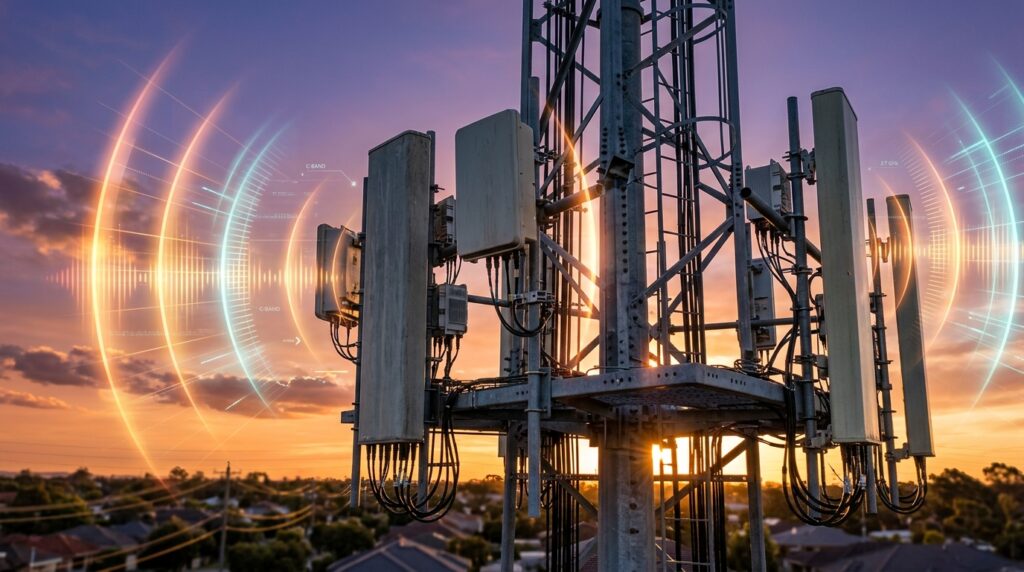
The radio frequency behavior has an impact on broadband quality and mid-band spectrum is a sweet spot. Low-band frequencies below one gigahertz penetrate barriers and cover wide regions, but their narrow channels soon fill up. Millimeter wave bands can provide very high speeds but need near line-of-sight and closely spaced cells, which is costly in suburban settings with trees and curving streets. Wide bandwidth support and the ability for sub-6GHz C-band channels to extend several kilometers under reasonable conditions make them ideally suited to serve neighborhoods from existing macro towers. Operators can also use enormous MIMO antenna arrays and beamforming to direct energy onto specific residences, increasing signal strength and reducing interference. That combination lets a provider serve lots of addresses from one site and still deliver speeds that can compete with cable and entry-level fiber services. That carriers have focused on home internet has a lot to do with economic efficiency.
Suburban Deployments: Capacity and Throughput Enhancements
In some areas where C-band has been introduced, suburban FWA subscribers have generally experienced considerable improvements in download speeds and in the constancy of those speeds. Wider routes improve the total capacity of each sector, so more households may be served before congestion arises. Typical speeds are on the order of 100 to well over 300 megabits per second depending on distance, signal quality and the local load, although latency is generally low enough to support video conversations and cloud gaming. Upload speeds have also improved, but are still constrained by the time-division duplex architecture which prioritizes downlink traffic by providing it with greater airtime. This ratio can be tuned by the operators, but it affects mobile customers sharing the same cell. The benefits are clearest in places where legacy FWA used limited 4G LTE channels that often slowed down during nighttime peak hours when streaming demand was highest.
Coverage, Propagation and the Suburban Environment
The radio environment is a mixed bag in the suburbs. Single-family houses are more spread out than in dense cities, reducing building blockage, although mature trees, hills, fences and energy-efficient glass can diminish signal strength. Because C-band runs at higher frequencies than the earlier low-band spectrum, it loses more energy going through foliage and building materials, hence its coverage footprint is lower than that of the traditional 4G layers. Operators respond with small cells, antenna upgrades on existing towers and carrier aggregation to marry C-band with lower frequencies to increase range. Homes on the edge of the cell may still experience slower or less reliable service, particularly if something is blocking the line of sight between the house and the tower. Managing expectations through careful network planning, drive testing and address-level eligibility checks. Increased deployment density slowly reduces the holes in coverage and the disparity between neighboring streets.
Customer Premises Equipment and Installation Quality
FWA performance is heavily dependent on home equipment. Indoor gateways are easy to set up, but the signals will have to travel through walls and windows first, which can noticeably limit speeds. Receivers with higher gain antennas located on windows or outdoors generally provide better signal quality and more consistent throughput, especially in suburban houses with metal siding or low-emissivity glass. More recent devices enable bigger channels in the C-band, more sophisticated modulation and more antenna streams, so earlier gateways may not enjoy the full benefits of reallocation. Placement is also important; even relocating a device a few feet closer to a window can greatly enhance the signal to noise ratio. Many suppliers now offer guided installation capabilities in mobile apps to assist customers in finding the right spot. The quality of Wi-Fi within a home also impacts perceived speed, so mesh systems or better routers can help ensure the home network doesn’t become a new bottleneck.
Congestion Control and Sharing the Network with Mobile Users
FWA uses the same spectrum and radio resources as smartphone traffic, therefore capacity control is important. A home broadband connection uses hundreds of times more data than a normal phone, thus even a small number of subscribers can tax a sector. Operators tackle this by restricting FWA sales to locations with available capacity, and utilizing eligibility maps that alter as network conditions change. They may also employ traffic management practices that give priority to mobile voice and data during peak times, which can result in slower home internet connections in the evening. C-band’s extra capacity relieves some of the stress, but not all of it. Cell splitting, more carriers, and smarter scheduling algorithms all assist balance the demand. For consumers, the practical result is that performance might vary throughout sectors and at different times of the day, typically based on how many neighbors are using the same cell.
Interference, Aviation Safeguards and Regulatory Constraints
Reallocation also brought technical and regulatory safeguards, which affect real-world performance. Concerns over interference to aircraft radio altimeters (which operate in a neighboring frequency range) motivated regulators and operators to impose power limitations, and buffer zones, around several airports. In the suburbs near airports, that could imply lower transmit power or limited antenna orientation, which cuts down coverage or restricts speeds from other places. The guard band between terrestrial and satellite services gives extra safety, but the other satellite earth stations still require careful management of interference. Timelines clearing generated unequal availability, with certain channels being usable earlier than others. In turn, operators rolled out the service in stages and users in the same metro region sometimes experienced varying results. Over time, modified aircraft equipment and new guidelines are expected to reduce these limits, although compliance will continue to be a consideration in network design.
What’s next for FWA if spectrum allocation continues to change
We expect to see continued improvement in FWA performance in suburban markets as operators complete clearing, densify their networks and add more spectrum. Additional mid-band spectrum, including upper C-band and adjacent bands, might push capacity even further. Standalone 5G core networks will unlock capabilities like network slicing that can deliver more reliable speeds for home internet. Better receivers, Wi-Fi 6 and Wi-Fi 7 gateways, and AI-powered network optimization will lift the ceiling for the average user. And competition from cable and fiber providers will undoubtedly increase, as well, pushing prices and service quality in consumers’ favor. The pace at which these benefits materialize will depend on policy decisions about the future of spectrum auctions and sharing arrangements. Finally, C-band reallocation is not a one-off occurrence but the beginning of a longer-term transition, when wireless broadband becomes a common supplement to wired connectivity.