How Web Accessibility Standards Fail Screen Readers When Processing Highly Formatted Mathematical Formulas Online
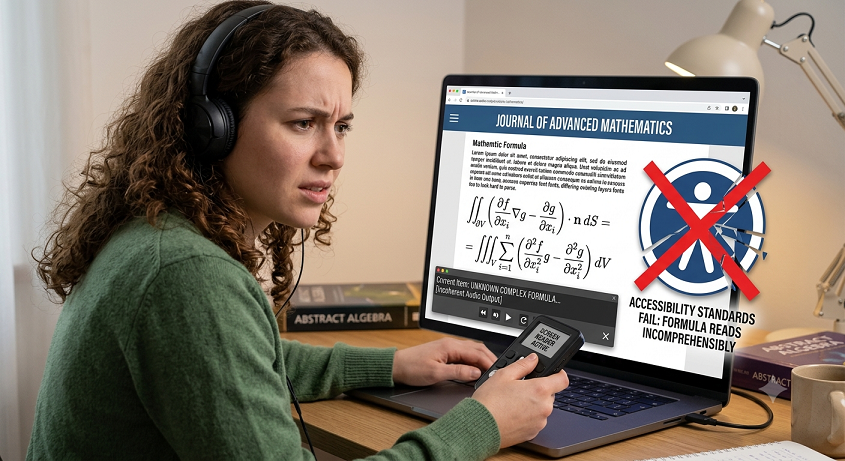
How Web Accessibility Standards Fail Screen Readers When Processing Highly Formatted Mathematical Formulas Online
Over the last decade web accessibility has moved forward substantially, making digital information more useable for those with visual, aural, cognitive and motor disabilities. Accessible design standards direct developers to produce websites that perform well with many different assistive technology such as screen readers. Even with these developments, mathematical content is still among the hardest types of information to make accessible. Highly structured equations usually depend on complicated visual layout that is hard to convert into meaningful spoken output. This results in confusion , incompleteness or misinterpretation of formulas for users relying on screen readers while viewing educational content , scientific papers or technical documentation . Understanding these restrictions helps developers create mathematical material that is both visually accurate and accessible to a wider audience.
Why Mathematical Content is Different from Normal text
Mathematical expressions, in contrast to normal paragraphs, communicate meaning via spatial connections, symbols, superscripts, subscripts, fractions, matrices and nested structures. These visual groupings are immediately interpreted by readers, who see interrelations that transcend beyond the order of individual characters. But screen readers mostly deal with content as linear information, reading it element by element. Converting a two-dimensional mathematical plan into a coherent spoken sequence requires meticulous structure knowledge which is sometimes lacking on many online pages. If there is not enough semantic markup, screen readers may read out the individual symbols without any context of how they relate to the rest of the equation. This can make complex formulas hard or impossible to interpret correctly.
The Problem with Highly Formatted Equations
Modern websites often present mathematical calculations using sophisticated formatting techniques to increase both readability and visual accuracy. Equations can have stacked fractions, integral signs, matrices, piecewise functions, limit expressions, and exponents nested to many levels. These visual representations may seem correct to sighted users, but they can provide accessibility issues if their underlying structure is not full. Sometimes decorative formatting gets more attention than semantic structure, so assistive devices can not understand the intended mathematical relationships. In fields where accurate mathematical communication is necessary, the distance between visual presentation and accessible interpretation grows as the complexity of equations increases.
How Screen Readers Understand Mathematical Information
The visual look of web material is not conveyed by structured information that screen readers use. If mathematical expressions are marked up semantically correctly, then assistive technology can recognize the operators, variables, grouping symbols and hierarchies of the expression before they generate the spoken descriptions. The problems arise when equations are provided solely as stylized text, static graphics or visually arranged symbols without any relevant structural metadata. In such cases, screen readers may receive punctuation, spacing characters or formatting instructions instead of the intended mathematics. Even small variations in structure can dramatically change the interpretation of the spoken word, which makes formulas difficult to follow for users of educational or professional duties.
Shortcomings of Existing Accessibility Implementations
Accessibility guidelines support the construction of semantic information . The level of implementation varies considerably from website to website and web application to web application . Most content management systems are concerned on visual rendering of material with little support for organized mathematical markup. Automated equation generators may create visually correct output, but lack adequate accessibility information to be used with assistive devices. Browser differences add another level of complexity as math rendering engines and accessibility interfaces are not always consistently implemented. This means the same equations can be interpreted differently by the person consuming the content depending on the browser, OS, screen reader and rendering technology being utilized.
Effects on Technical Training and Education
The accessibility constraints of mathematical formulae have important implications in educational contexts. Students who use screen readers often find it harder to study math, engineering, physics, economics, and computer science since equations include necessary instructional content instead of ancillary information. Misreading formulas may change the methods of problem solution, impair understanding and raise cognitive effort in autonomous learning. Technical workers who use assistive technologies can encounter comparable difficulties when examining research papers, software manuals or analytical reports that involve advanced mathematical notation. Thus, making equations more accessible can help in scholastic accomplishment as well as inclusion in the workplace in many technical fields.
Better Design for improved mathematical accessibility
You have to consider how you present and structure accessible mathematics to write it. Marking up semantic content should be based on the logical linkages contained in each equation, not just the way it looks. Developers should ensure that mathematical expressions maintain a meaningful hierarchy, regardless of display style or device size. Alternative textual explanations can further help users who encounter particularly complex formulas by discussing the general purpose and context of an equation in addition to its symbolic representation. Also, testing mathematical content with several assistive technologies helps to uncover discrepancies that eye inspection may miss, resulting in better accessibility in different user settings.
Browser and Assistive Technology Compatibility: Why It Matters
Accessibility is not just about having well-structured web content, it is also about effective communication between browsers and assistive technology. A browser’s accessibility interfaces transform the content on a web page into formats that can be efficiently interpreted by screen readers. Differences in the rendering engines, available application programming interfaces, and math processing capabilities can affect the pronunciation of equations. Support for accessible mathematics is increasing with browser compatibility improving, although there are still differences between software environments. Thus, developers need to test the mathematical content in several browsers and assistive technologies to ensure that crucial expressions remain readable in different technical environments.
“Towards a More Inclusive Mathematical Web”
Accessible mathematics is a team effort comprising web developers, browser engineers, assistive technology suppliers, educators, and content authors . As digital learning becomes more prevalent in educational, scientific, and professional contexts, mathematical accessibility will be increasingly vital for equitable access to technological subjects. Future advances in semantic markup, browser support, accessibility frameworks, and screen reader capabilities will likely alleviate many of the constraints experienced today. Until then, developers who care about meaningful structure as much as they care about visual beauty may do a lot to make arithmetic more accessible to users of assistive devices. By building equations that communicate successfully through both visual presentation and semantic organization, the web may be made into a more inclusive environment in which mathematical knowledge stays accessible to everyone, regardless of how they access digital content.