The Rise of “Agentic Marketing”: How Brands are Using Autonomous AI to Manage 24/7 Customer Journeys
The Rise of “Agentic Marketing”: How Brands are Using Autonomous AI to Manage 24/7 Customer Journeys
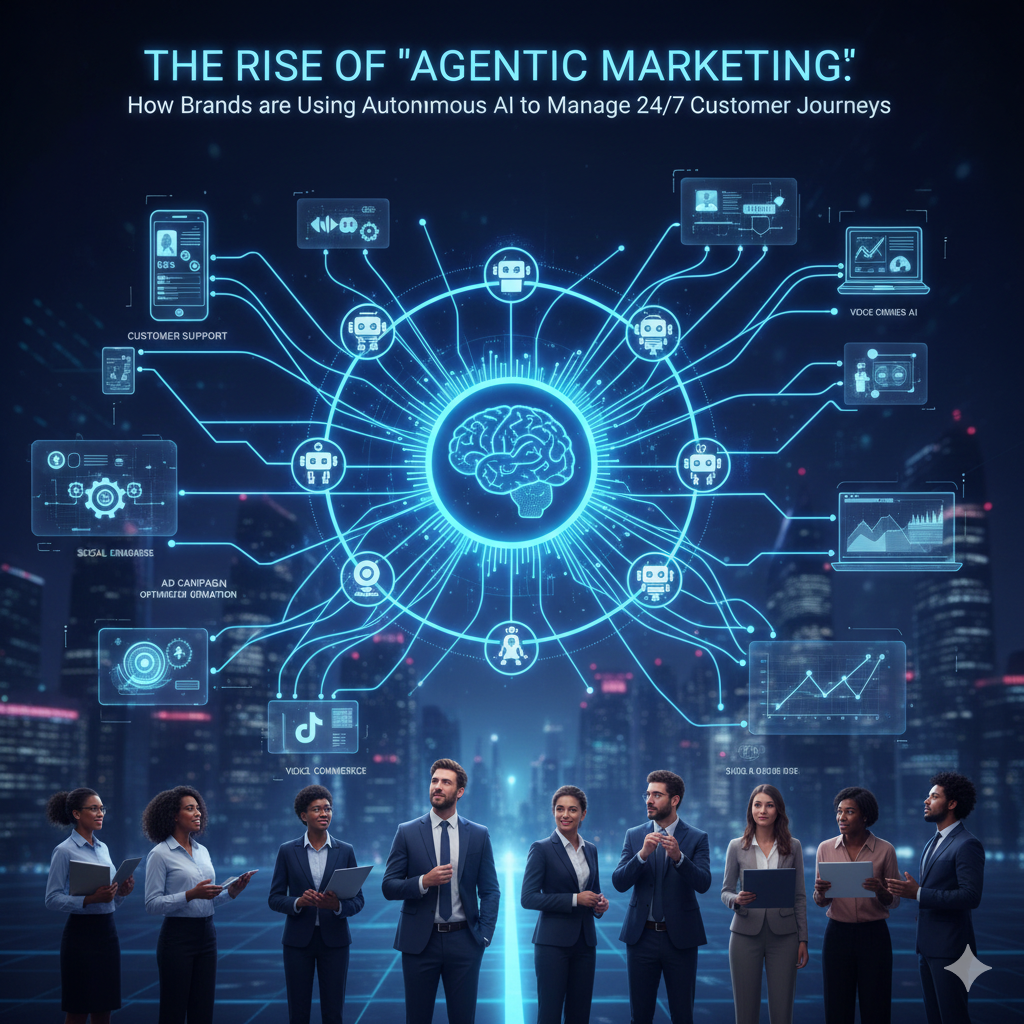
Agentic marketing is a new paradigm in which autonomous artificial intelligence technologies are entrusted with the responsibility of orchestrating substantial chunks of the customer experience with minimum participation from humans. Agentic marketing distinguishes itself from conventional marketing automation, which operates according to predetermined sequences, by empowering artificial intelligence agents with the ability to read real-time data, make choices, customize experiences, and maximize results across channels autonomously. It is because of this transition that businesses are able to work around the clock, adapt dynamically to context, and customize interactions at scale. This is redefining the way in which companies communicate with their current consumers as well as potential customers.
The Difference Between Traditional Automation and Agentic Marketing: An Understanding of the Differences
Agentic marketing, at its foundation, gives artificial intelligence the ability to act rather than merely go through pre-programmed duties. The conventional method of marketing automation is dependent on processes that are established by people and that follow predictable routes based on predetermined triggers. Unlike traditional systems, agentic systems are able to recognize signals from customers, make real-time adjustments to plans, and choose actions depending on the goals that are established by marketers. For the purpose of determining what message to send, when to send it, over which channel, and with what offer or content, these systems make use of reinforcement learning, contextual natural language comprehension, and predictive modeling. The end result is a marketing apparatus that does not act like a static tool but rather behaves more like an autonomous agent in a competitive environment. This apparatus is capable of continually learning and optimizing itself.
The Technology Stack That Is Responsible for the Autonomous Customer Connection
Real-time data processing, artificial intelligence decision engines, natural language creation, and cross-channel orchestration are all components that are included into the technological stack that allows agentic marketing to function. In order to discern intent and preference, artificial intelligence models are fed data streams from customer relationship management (CRM) systems, website interactions, social media engagements, purchase histories, and behavioral datasets from third parties. Following this, the decision layer conducts an analysis of the prospective actions by comparing them to key performance measures such as the chance of conversion, the lifetime value, and engagement metrics. While delivery systems guarantee that messages are carried out in a smooth manner across email, messaging applications, websites, and in-app alerts, natural language generating capabilities allow for the customization of communications to various unique personalities. Monitoring and feedback systems are the foundation of the whole stack. These techniques allow for the ongoing improvement of strategy without the need for constant human supervision.
Personalization at Scale: Tailored Experiences Available Around the Clock
Agentic marketing offers a number of attractive benefits, one of the most convincing being the capacity to create tailored experiences at scale and at any hour. AI that is autonomous does not experience weariness, does not need breaks, and is able to react instantaneously to changing behaviors. For instance, if a consumer hesitates on a checkout page because it is late at night, an agentic system may detect the hesitation, determine the underlying friction point, and then decide whether to provide a discount, give extra information, or launch a conversational interface to help the user. Additionally, the artificial intelligence has the ability to aggregate signals and customize messages that connect with the individual path of a high-value prospect who is researching items on different platforms. This allows the AI to effectively operate as a personal marketer who is available around the clock.
Increasing the Loyalty of Customers Through Effective Engagement Opportunities
The ability of agentic marketing to provide proactive engagement techniques is another way that loyalty is redefined. Instead of waiting for indications that suggest a gap in interest, autonomous AI may forecast churn risk, select the most effective retention offer, and reach out to customers before they disconnect from the service. A decrease in interactions or a delay in repeat purchases are two examples of the antecedents of customer attrition that may be identified by these systems via the analysis of trends across cohorts and individual consumers. The cultivation of deeper loyalty and the enhancement of client lifetime value are both achieved by businesses that respond early and effectively. Loyalty programs that are handled by agentic systems morph and change over time, modifying incentives and messages to correspond with the factors that motivate real commitment from each individual consumer.
Ethical Considerations and Corporate Governance of Artificial Intelligence
Ethical issues and governance frameworks are becoming more important as companies use autonomous artificial intelligence to manage consumer experiences. Concerns around transparency, consent, fairness, and data privacy are raised as a result of the choices that are made by agentic systems. These judgments have the potential to impact consumer behavior, spending, and views of the brand. Clear regulations about the manner in which choices are made, the data that is utilized, and the means by which consumers may opt out of receiving specific messages or understand the reasons why they got them are required by ethical AI governance. The implementation of guardrails is necessary for brands in order to put an end to manipulative activities, guarantee compliance with data protection requirements, and preserve the confidence of their customers. In order to be considered responsible agentic marketing, transparency reports and explainability procedures are essential components.
How to Evaluate Success in a Marketing Environment That Is Completely Independent
When it comes to agentic marketing, performance evaluation no longer consists of analyzing discrete campaign KPIs but rather of evaluating the results of the whole trip. Not only are brands required to monitor traditional metrics like click-through rates and conversion percentages, but they must also monitor long-term effects such as client retention trajectories, levels of satisfaction, and revenue per engaged user. In order to better comprehend how autonomous agents are functioning in relation to strategic objectives, marketing directors may benefit from real-time dashboards and insights provided by artificial intelligence. For the purpose of isolating the impact of agentic acts in comparison to conventional marketing efforts, advanced assessment frameworks contain control groups and incremental lift studies.
Bringing together human oversight and autonomous decision-making at the same time
In spite of the great degree of autonomy that agentic systems possess, human monitoring is still essential in order to guarantee that they are aligned with the values of the brand and the strategic goal. It is necessary for marketers to establish unambiguous goals, establish risk thresholds that are acceptable, and keep track on high-level performance trends. It is important for human teams to regularly examine the choices that are made by AI agents in order to ensure that the customer experiences continue to be in line with the brand voice and ethical standards. The optimal arrangement combines the computing power of artificial intelligence with human judgment, particularly in situations that are difficult or sensitive and where subtlety and empathy are of the utmost importance. In this hybrid approach, autonomous systems are responsible for making decisions that are repetitive and high-velocity, while humans concentrate on developing new strategies and exercising ethical leadership.
Using artificial intelligence to create a future landscape of customer journeys
When we look to the future, we can see that agentic marketing will get more complex as artificial intelligence models become more adept and interconnections go farther across digital ecosystems. The capacity to innovate in real time, decreased operational overhead, and hyper-efficient client interaction are all benefits that will accrue to brands who implement these solutions at an early stage. Because of the intensification of competition, customers will come to anticipate individualized and seamless interactions at each and every touchpoint. This is something that can only be delivered in a sustainable manner at scale by autonomous and intelligent systems. Agentic marketing is not only an advantage for businesses that want to lead in the digital era; it is a must for those brands that want to be successful in the future. The future of customer journeys is continuous, adaptable, and driven by artificial intelligence that understands and reacts to human needs with accuracy.