The Impact of CPU Throttling on Cryptographic Operations Performed within WebAssembly Modules
The Impact of CPU Throttling on Cryptographic Operations Performed within WebAssembly Modules
WebAssembly has become a powerful technique for executing high-performance apps natively inside modern web browsers. Developers can run near-native code for intensive processes like scientific computation, multimedia processing, engineering simulations, and cryptography procedures without needing to install standard desktop applications. Many secure web applications today use WebAssembly modules for efficient encryption, decryption, digital signature verification, password hashing, and secure key management in the browser. WebAssembly offers a huge increase in computing performance but it really depends on the processing resources you have. One element that can significantly affect the speed of execution is CPU throttling. CPU throttling is a mechanism used by operating systems and hardware to decrease the performance of the processor under specific conditions. By better understanding how CPU throttling affects cryptographic workloads, developers may build browser-based security solutions that are more dependable and responsive.
WebAssembly Performance Understanding
WebAssembly is a compact binary format for representing instructions, allowing browsers to run compiled code efficiently. Unlike traditional JavaScript, which is interpreted and optimized at run-time, WebAssembly is designed to reduce processing overhead and provide consistent performance across platforms. This allows the device to do computationally complex processes that need millions of mathematical calculations in short times. This design is particularly useful for cryptographic algorithms since they repeatedly carry out difficult arithmetic, memory operations and bitwise computations that require consistent processor performance.
Processor Utilization in Cryptographic Operations
Modern cryptography algorithms can do much more than just encrypt data. They do mathematical operations over and again. They produce cryptographically strong random numbers. They verify digital signatures. They create keys for encryption. They check that the message has not been altered. Depending on the quantity of the protected data and the complexity of the specified algorithm, these processes often involve thousands or even millions of processor instructions. So, browser-based encryption modules built with WebAssembly depend on sustained CPU speed to do calculations quickly and still keep the user experience responsive.
What Is CPU Throttling
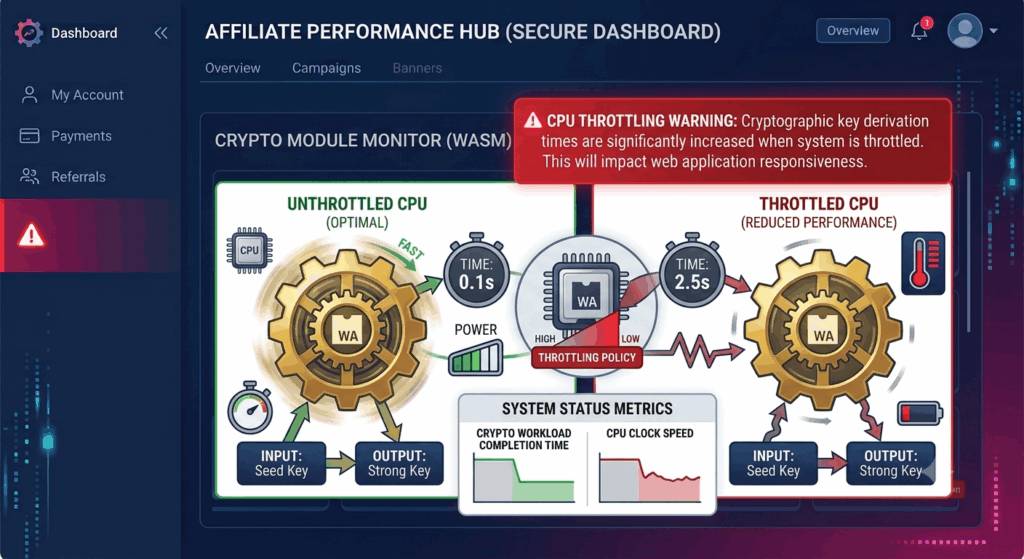
CPU throttling is a function of hardware and operating system that restricts processor performance on the basis of temperature, power consumption, and workload conditions. When a CPU nears thermal or power constraints, it can automatically lower its operating frequency to minimize overheating, conserve battery power, or regulate operation of the system. This behaviour guarantees hardware stability but at the expense of reducing the amount of instructions the processor can execute per second. Thus, reducing the speed of the processor increases the time to run computationally complex WebAssembly modules to do the same cryptographic functions.
Temperature Control and Continuous Workloads
Encryption of huge files, secure data synchronization, certificate validation or password hashing. These processes generally need constant use of cryptographic processing which can be very demanding for the processor. The processor is still busy, and the gadget temperature is slowly rising. These temperatures are constantly monitored in today’s computers and mobile devices and will trigger thermal management systems when pre-defined thresholds are reached. Processor frequencies can then be reduced in steps until safe operating conditions are re-established. These changes, while beneficial to device longevity, can have a significant impact on the speed of cryptographic operations when performed in a browser context where continuous compute throughput is important.
Mobile Device Battery Optimization
Cellphone operating systems aggressively tune the behavior of the processor to maximize battery life. Energy management systems could deliberately back off the processor even before temperature limitations are reached, particularly during long browsing sessions, especially on battery-powered devices. WebAssembly modules that carry out repetitive cryptographic computations must contend with power-saving rules that enhance the overall device efficiency. This can lead to a decrease in the encryption speed, the authentication process, or the time needed to process a secure file on battery-powered devices against the same hardware connected to external power.
Performance Symptom Identification
When CPU throttling affects applications, they tend to degrade over time, not just fail. Encryption activities that take a few seconds to run now, could take minutes or longer, if CPU frequency decreases. Longer work loads can result in noticeable performance degradation in secure file transfer, browser based certificate production, password derivation and digital signature verification. In addition, when cryptography processing requires a substantial amount of processor capacity, users could notice a sluggish interface response as the browser concurrently processes rendering, networking and background application logic. These symptoms are usually a sign of resource constraints, not of any failure in the cryptographic algorithms themselves.
Strategies for Achieving Consistent Performance
Developers can increase the efficiency of cryptography in browser applications by writing WebAssembly modules that make the best use of the available processor resources and do not waste any computing effort. Browsers can remain responsive even during long calculations by breaking very big operations into smaller processing steps. Efficient memory management also decreases the additional stress on the processor caused by frequent data migration. Users are also advised to keep browsers and operating systems up to date . Newer releases often increase WebAssembly execution performance , processor scheduling , and power management coordination . Good device cooling and enough system resources also make it less likely that the CPU will aggressively throttle itself during long periods of cryptographic activity.
Design of High Performance Secure Web Applications
As browser technologies continue to evolve, WebAssembly will play a greater role in providing sophisticated security features directly through online applications. At the same time, processor power management will continue to be critical in balancing performance, energy efficiency and hardware dependability across desktops, laptops and mobile devices. Developers who understand how CPU throttling, WebAssembly execution, and cryptographic workloads interact can create applications that stay responsive under a variety of operating situations. By designing efficient algorithms, managing resources carefully, performing thorough performance testing, and being aware of hardware limitations, organizations can build secure browser-based applications that provide consistent cryptographic performance and can adjust gracefully to the dynamic resource management strategies of modern computing platforms.