The Operational Challenges of Transitioning High-Density Data Centers to Direct-to-Chip Liquid Cooling Architectures
The Operational Challenges of Transitioning High-Density Data Centers to Direct-to-Chip Liquid Cooling Architectures
Rack power densities have increased much beyond what standard air cooling was meant to handle. Today, artificial intelligence training clusters, high performance computing systems and dense cloud servers push processors and accelerators beyond seven hundred watts each, and entire racks often reach forty or even one hundred kilowatts. That much heat moving with fans and cold air is becoming inefficient, noisy and pricey. Direct-to-chip liquid cooling solves this by running coolant through cold plates right on the processors, memory and accelerators, reducing heat at the source. The technology promises lower energy consumption, increased density and more steady performance. But you can not just swap equipment to go from air to liquid. It changes the way facilities are designed, maintained and protected and the way vendors are selected and managed. This paper covers the operational problems data center teams encounter during transitions and practical strategies that can help mitigate risk.
Air Cooling Approaching Its Practical Limits
Air has a poor heat capacity . This means you need enormous volumes to pass over hot components to transfer heat away . The more power in the rack, the quicker the fans have to spin, taking up more and more of the server’s energy and creating noise and vibration that might impact storage devices. Hot aisle and cold aisle containment, rear door heat exchangers and higher supply temperatures prolong the life of air systems, although each enhancement has diminishing benefits. Modern accelerators also get hotter and thermal throttling limits performance when chips can not get rid of heat fast enough. Water, in contrast, can absorb thousands of times more heat per unit volume and hence is far more effective at removing thermal load from compact cold plates. Operators that neglect this physical gap risk stranded capacity—power available at the building level that cannot be used because the room cannot reject the heat.
Existing Facilities and Infrastructure Limitations: Retrofits
Most older data halls were designed with high floors, overhead air handling, and low rack loads, thus liquid retrofits are seldom simple. 2-3 times the weight of traditional cabinets and include coolant and heavy accelerators. Floor loading capacity is important. Liquid cooled racks. Available ceiling space, cable trays and underfloor channels may limit additional piping and routing around active equipment poses construction risk in an operating environment. Electrical systems often need changes as well, as more density typically means higher power demand per rack. Facility teams also have to determine whether to convert entire rooms or set up specific high density zones, a decision that has cost, disruption and future flexibility implications. Phased projects with clear demarcation between air-cooled and liquid-cooled regions help preserve uptime, but they require extensive planning, careful scheduling of maintenance periods and good coordination between facilities, IT and construction contractors.
Coolant Distribution Units, Piping and Manifold Design
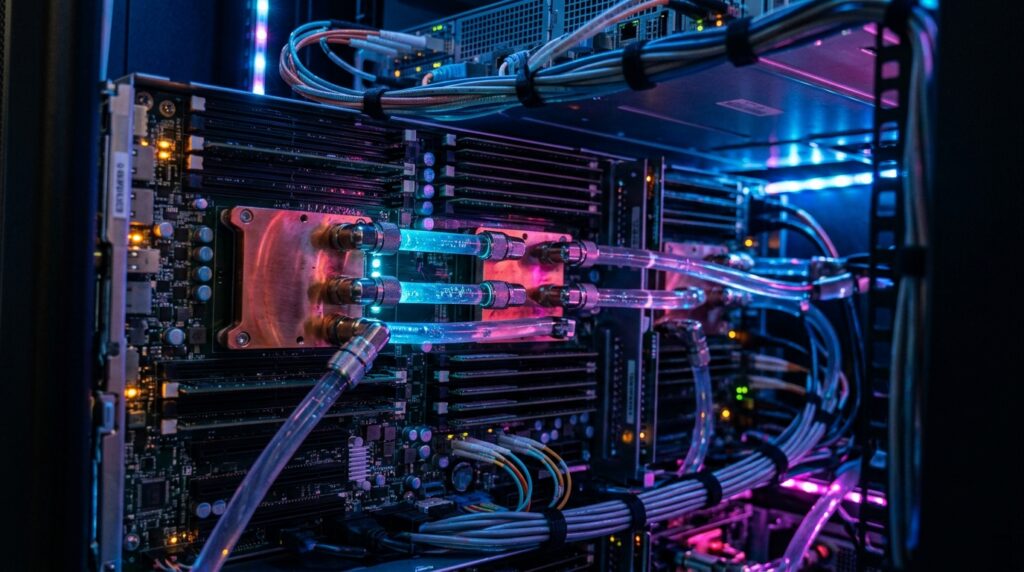
At the heart of a direct to chip system is the secondary fluid network that links racks to coolant distribution units that transport heat to the facility water loop. Careful consideration to flow rates, pressure drop, redundancy and temperature approach are required to design this network. If the piping is undersized or the manifolds are unbalanced, certain servers may be short on coolant while others get too much, resulting in uneven thermal performance. These key components are often redundant, with automatic failover and variable speed controls that match flow to heat load. The type of material used also makes a difference, as mixing copper, aluminum and other metals can create galvanic corrosion. Standardize hoses, quick disconnect couplings, and rack manifolds. Incompatible parts impede maintenance and replacement. Operators must next determine where to put the distribution units – in the row, at the rack, or in a central plant – each having its own trade-offs in efficiency and complexity.
Leak Prevention, Detection and Management
For data center operators, few issues are more daunting than the prospect of liquid in close proximity to live equipment. Well-designed systems use sealed loops, dripless quick disconnects, and low operating pressure, but the danger cannot be discounted since each connection point is a possible failure area. Operators are consequently provided with multiple layers of safety, including leak detection cables, drop trays, humidity and pressure sensors, and automated shutdown valves that separate areas when anomalies are detected. Before any server is connected, the commissioning processes should involve pressure testing and flushing. Staff need to be able to identify who can shut down a loop, how to inspect the damaged hardware, and how warranties and insurance apply after an occurrence. Approved fluids and components may also have vendor criteria for maintaining coverage. Open communication between facilities teams and risk managers helps set realistic expectations, because the goal is to manage a tiny, well-understood risk, not pretend it doesn’t exist.
Fluid Quality Water Chemistry and Long Term Maintenance
Coolant is not a passive ingredient and the health of cold plates and pumps depends on its state. Most direct-to-chip systems use purified water or a mixture of water and glycol and require chemical management to minimize corrosion, scaling and biological development. In current cold plates the microchannels are very thin and so even minute particles or deposits can block the flow and reduce heat transfer. Thus operators must install filtration and monitor conductivity, acidity and inhibitors and arrange periodic sampling and fluid replacement. Installation of a new loop to a facility also requires strict cleanliness and flushing standards. Fluid management ownership should be defined in maintenance contracts. Often, this obligation is between facility and IT departments. Small chemical drifts can go unnoticed in the absence of unambiguous ownership until performance degrades or fails, turning a straightforward routine procedure into an expensive and disruptive repair.
Hybrid Cooling Environment Management and Capacity Planning
Direct-to-chip cooling does not remove the requirement for air. Cold plates usually take care of half to four-fifths of the heat a server throws off, but the memory modules, power supplies, storage drives and networking gear still warm up the space. Data centers run hybrid settings where liquid and air systems must be sized together. Hot spots may arise if the residual air load is underestimated. Conversely, overbuilding air capacity is a waste of money. Capacity planning is more difficult since even in a single hall, the thermal profiles and development trajectories of racks might vary greatly. Facility water temperature also influences chiller operation, free cooling hours and overall efficiency, therefore greater supply temperatures should be carefully weighed against hardware specifications. Next-gen chips may generate more heat than present cold plates and loops were designed to remove, thus planners need adaptable designs that can grow as accelerator generations change.
Vendor Coordination, Processes and Workforce Skills
Technicians trained in electrical systems and airflow control may have no experience in hydronic systems, fluid handling or leak response. New processes are needed to hot swap servers, drain and refill loops, and work safely around pressurized lines. Training must be provided to both facilities and IT professionals, because maintenance activities now cross boundaries. Vendor coordination is another layer of difficulty, as server makers, cold plate suppliers, distribution unit manufacturers and facility contractors may each add a piece to the puzzle. Troubleshooting without clear attribution can lead to an argument as to whose component caused the problem. Standard operating procedures, standardized documentation and collaborative commissioning tests all help to prevent uncertainty. Over time, many operators develop internal expertise but bring in specialists with mechanical or plumbing backgrounds or work with managed service companies. Investing early in people is frequently as vital as investing in equipment.
Monitoring, Standards and the Road to Scalable Adoption
Liquid cooling adds a new set of operational data such as flow rate, supply and return temperature, pressure, and component level thermal data. When these signals are integrated into building management and data center infrastructure management platforms, teams can spot trends and act before issues become more serious. Predictive analytics can detect pump wear, filter blockage or slow flow reduction long before an outage happens. There are still gaps, but industry norms for coolant connectors, rack designs and temperature guidelines are emerging, and that helps reduce costs and increase interoperability. Where possible, operators should embrace open designs to avoid vendor lock-in. Sustainability benefits also require consideration, as efficient heat removal can lead to lower energy consumption, heat recovery for surrounding buildings and reduced water use if closed loops are used instead of evaporative cooling. A pilot-first approach that begins with a small deployment and learns from real operating data provides a safer route to scale for companies.