Troubleshooting Apple Podcasts Chapter Marker Parsing Errors in Custom MP3 Metadata
Troubleshooting Apple Podcasts Chapter Marker Parsing Errors in Custom MP3 Metadata
Podcast authors who take the trouble to add chapter markers to their MP3 files often anticipate that their recordings would play without any interruptions across all devices. However, Apple Podcasts may react in an unpredictable manner when processing special information. In spite of the fact that chapter markers improve the listening experience by making it possible to navigate among episodes, even slight formatting issues might lead them to perform completely poorly. These difficulties are especially aggravating due to the fact that the audio file could seem to be perfect in editing software, yet it might still be broken in Apple’s environment. Apple Podcasts’ interpretation of ID3 information, which must comply to stringent structural and encoding rules, is the source of the issue. This interpretation is the foundation of the problem. These expectations may be violated in a variety of ways, including slight deviations, which can lead to chapters being misrepresented or absent entirely. In order to accurately diagnose these issues, it is vital to have a solid understanding of the metadata structure that lies behind them. In order to guarantee that the operation of the chapter is dependable, designers must first recognise typical issues and then implement specific remedies. A rigorous approach to the validation of metadata has the potential to dramatically enhance compatibility as well as the experience of the listener.
Acquiring Knowledge of the ID3 Metadata and the Chapter Frame Frame Structure
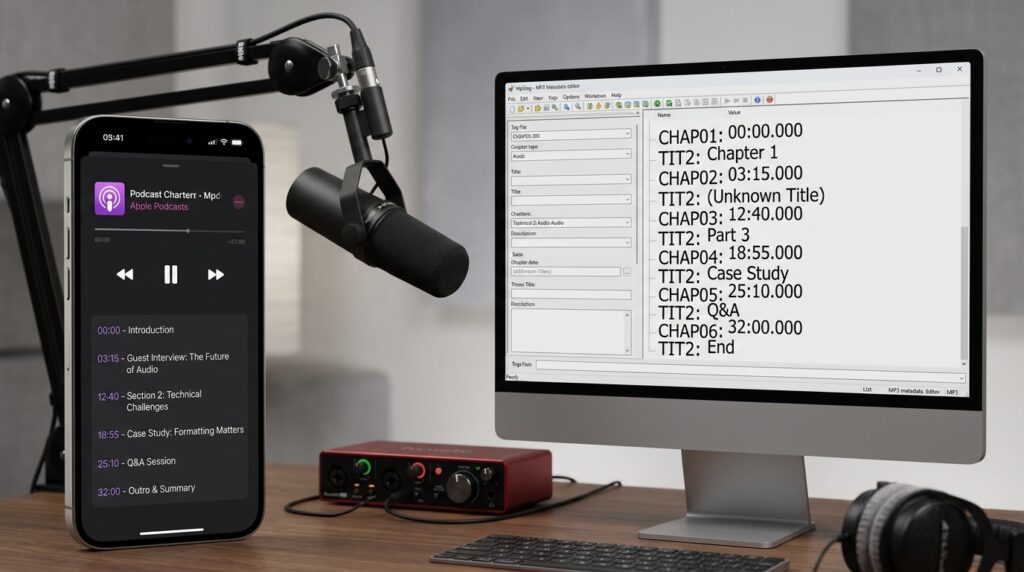
Using certain frame types that are intended to indicate time-based segments, MP3 chapter markers are stored inside the metadata of the ID3 file. Despite the fact that Apple Podcasts is largely dependent on the ID3v2.3 or ID3v2.4 standards, it is especially sensitive to the arrangement of chapter frames. In contrast to the CTOC frame, which organises the chapters into a table of contents, the CHAP frame is responsible for defining individual chapters. Each CHAP frame is required to include correct timestamps for both the beginning and the conclusion, in addition to names and URLs that are optional. In the event that any of these components are either missing or not present, Apple Podcasts may choose to disregard the whole chapter set. The sequence in which frames are included inside the metadata may also have an effect on the behaviour of the parsing process. Apple is more stringent in its compliance requirements, in contrast to other players that may be forgiven for slight irregularities. In order to achieve proper parsing, it is essential to make certain that the metadata adheres to the appropriate structure.
Formatting errors that are common and may cause chapter parsing to fail
When it comes to CHAP frames, poor timestamp formatting is one of the most common reasons for parsing issues. The timestamps need to be accurate and in sync with the number of seconds that the audio file really represents. There is a possibility that Apple Podcasts may remove chapter data if the timestamps overlap or are outside of the acceptable range. Another typical problem is that chapter names are either not encoded correctly or are missing entirely, which may lead to markers that are either blank or illegible. The improper use of text encoding, such as the combination of UTF-8 and ISO-8859-1, may also result in errors in the parsing process. Furthermore, some tools embed additional frames or frames that are not supported, which causes Apple’s parser to get confused. The compatibility of two systems may be broken by even minute differences in the frame IDs or the lengths of the data. Identifying and fixing these formatting flaws is very necessary in order to ensure that the chapter presentation is dependable.
It is essential to make use of ID3 versions that are compatible.
It has been shown that Apple Podcasts is more compatible with ID3v2.3 than it is with ID3v2.4, despite the fact that both of these standards are commonly used. There are certain metadata editors that use ID3v2.4 as their default, which might result in minor incompatibilities. These may include variations in the way frames are handled, the rules for encoding, or the use of extra headers. When metadata is converted to ID3v2.3, parsing problems are often resolved without the need for significant modifications to be made to the content. In addition, it is essential to make certain that the file contains just a single version of ID3, since the presence of numerous versions raises the possibility of disputes. It is possible to increase consistency by removing tags that are either obsolete or redundant before adding new information. In order to begin the process of troubleshooting, it is essential to choose the appropriate version. The compatibility with Apple Podcasts may be considerably improved by making this really simple tweak.
Things to Think About Regarding Encoding and Character Sets
Text encoding is an essential component in the process by which Apple Podcasts performs its interpretation of metadata. Inconsistent or unsupported encoding might result in the inaccurate display of chapter names and descriptions, or even the complete absence of information. While UTF-16 encoding is generally considered to be safe, it is essential that it be applied uniformly across all frames. Combining several encodings inside the same file might produce consequences that are difficult to anticipate. Particular characters and symbols need to be thoroughly verified since there is a possibility that they may not display properly in all circumstances. It is possible to limit the likelihood of parsing problems by ensuring that the whole metadata structure is encoded in the same manner. It is also possible to improve compatibility with other podcast systems by encoding things correctly. Due to the meticulous attention to detail, the information contained inside the chapter is preserved and may be easily read.
Specific Problems Associated with the Creation of Metadata
The chapter information is handled in a variety of different ways by various audio editing and tagging applications, which might result in discrepancies being apparent. It’s possible that some tools don’t completely support CHAP and CTOC frames, which might result in information that is either missing or wrong. It is possible for other people to introduce proprietary tags that disrupt the regular parsing process. The use of technologies that expressly enable podcast chapter markers and comply to ID3 criteria is of utmost importance. In order to guarantee that the metadata is written appropriately, it is important to carefully verify the export settings. Testing files created with different tools can help identify compatibility issues. In certain instances, the resolution of chronic issues might be achieved by moving to a tagging technique that is more dependable. Understanding the limitations of each tool is key to producing valid metadata.
Validating MP3 Files Before Publishing
Before uploading episodes to Apple Podcasts, it is essential to validate MP3 files to ensure metadata integrity. Validation tools can inspect ID3 frames, detect errors, and highlight inconsistencies. Checking for duplicate frames, incorrect timestamps, and encoding mismatches helps prevent parsing issues. Listening to the file in multiple players can also reveal discrepancies in chapter behavior. Ensuring that the file size, bitrate, and duration align with metadata values is equally important. Validation should be part of the standard publishing workflow. This proactive approach reduces the likelihood of errors reaching the audience. Consistent validation ensures a smoother listening experience across platforms.
Fixing Broken Chapter Markers in Existing Episodes
When chapter markers fail in already published episodes, the solution involves reprocessing the MP3 file with corrected metadata. This may require removing existing ID3 tags and rebuilding them from scratch. Updating timestamps, titles, and encoding ensures that the new metadata meets Apple’s requirements. Once corrected, the file must be re-uploaded to the hosting platform, which may trigger a refresh in Apple Podcasts. It is important to maintain the same file name and URL when possible to avoid breaking existing links. Testing the updated file before republishing confirms that the issue has been resolved. While this process can be time-consuming, it restores full functionality. Addressing errors promptly helps maintain listener trust and engagement.
Best Practices for Reliable Chapter Marker Implementation
To ensure consistent performance, creators should adopt best practices for implementing chapter markers. Using standardized metadata structures and compatible ID3 versions is essential. Keeping chapter titles concise and clearly formatted improves readability. Avoiding unnecessary or unsupported frames reduces the risk of parsing errors. Regular testing across different platforms ensures broad compatibility. Maintaining a consistent workflow for metadata creation and validation minimizes mistakes. Documentation of the process can help streamline future episodes. By following these practices, creators can deliver a polished and professional listening experience. Reliable chapter markers enhance usability and add significant value to podcast content.