How Content Security Policy (CSP) Directives Inadvertently Block Legitimate Third-Party Payment Gateways
How Content Security Policy (CSP) Directives Inadvertently Block Legitimate Third-Party Payment Gateways
Content Security Policy (CSP) has emerged as one of the most useful security strategies for modern web applications, allowing developers to secure websites against malicious scripts, illegal resource loading and different client-side assaults. CSP sets rigorous limits for what resources the browser can load or execute, which helps to mitigate risks such as cross-site scripting and illegal code injection. These security settings do improve application security but may also cause unforeseen compatibility problems with genuine third-party services. One of the most susceptible ones are online payment gateways as they rely on loading external scripts, secure frames, APIs and communication routes from many trusted sites. But if the CSP directives are excessively strict or are specified without addressing the needs of payment providers, browsers can quietly block critical resources and result in broken payment pages. By understanding how CSP interacts with third-party payment systems, developers can reliably process transactions with excellent security.
Learning Content Security Policy
Content Security Policy (CSP) is a browser-enforced security policy that allows web site managers to select sources that are allowed to deliver scripts, stylesheets, images, fonts, media, frames and network connections. Instead of loading resources freely , the browser cross checks each requested asset against the policy it has been given , and only then grants access . Resources from sites not specifically authorized are immediately blocked. This proactive strategy minimizes the potential for attackers to insert and run unwanted code and enables developers to manage the interactions of web apps with external material strictly.
Why Payment Gateways Use Third Party Resources
The payment gateways of today are not totally on the merchant’s website. Payment providers may also offer their own secure forms, authentication services, encryption libraries, fraud detection and transaction processing interfaces to protect sensitive financial information and meet with security regulations. During checkout, browsers may need to load scripts, render embedded payment frames, establish encrypted network connections or redirect users through secure authentication routines. Such operations generally entail numerous trusted domains administered by the payment provider, and access to external resources is a vital feature of efficient payment processing.
How CSP Directives Control Resource Loading
Each CSP directive governs a certain kind of browser activity. There are certain directives that control script execution, certain that control network requests, embedded frames, images, fonts or style resources. When the browser comes across a requested resource, it validates the request against the directive corresponding to it before it can be loaded. If the resource is from an unauthorized location, the browser promptly blocks it, without executing the related functionality. Though this behavior helps improve application security, it also breaks valid payment gateway components if their required domains are not present in the permitted policy configuration.
Typical Symptoms of CSP-Related Payment Failures
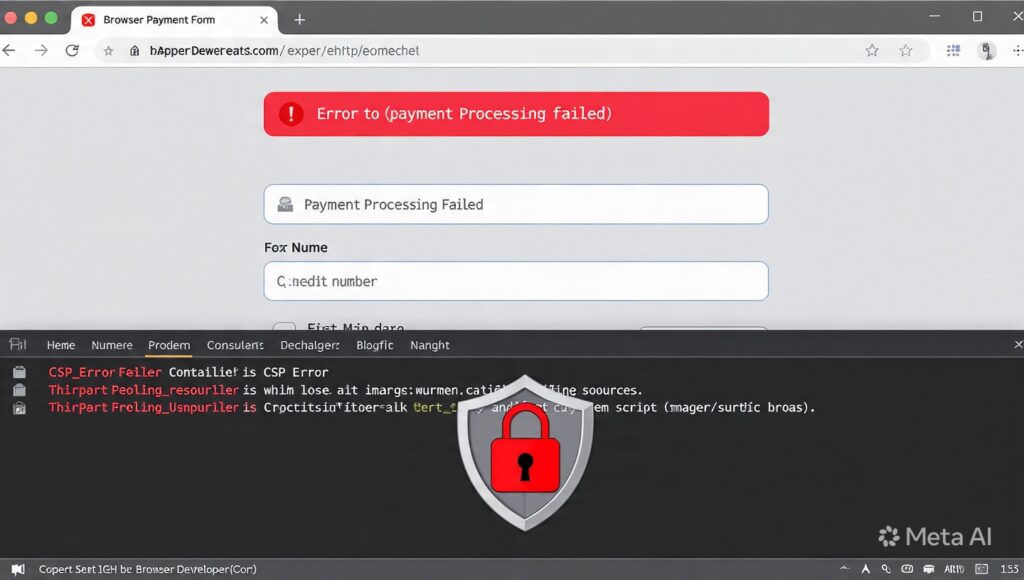
Payment gateway problems due by restricted CSP configurations are often puzzling because the checkout page itself might load correctly, yet other payment features silently fail. During transaction processing, users may click on payment buttons that do nothing or incomplete payment forms or unsuccessful authentication. Embedded payment frames can seem blank and external verification services might not initialize properly. Developers, while looking at the diagnostics tools in the browser, often see notifications about CSP violations. They tell you that some of the scripts, network requests or embedded resources that you need were banned before the payment processing even started. These are usually signs of issues with how policy is configured and not a failure of the payment gateway itself.
Multi-Domain Payment Services Complexity
Modern payment providers tend to break their functionality among many specialized services instead of a single server. One domain may be responsible for providing payment forms, another may be responsible for fraud analysis, and yet another for transaction validation, customer authentication, and security monitoring. Some content delivery networks are geographically spread to enhance performance and availability. Browsers examine each external resource in isolation, so each necessary domain must be consistent with the active CSP setup. Even if all other components are working perfectly, a missing valid service endpoint can disrupt the entire payment workflow.
Security and functionality need to be balanced.
A good CSP is designed to strike a balance between the need for tight security measures and practical application needs. Policies that let all external resources undermine security controls, and overly rigid setups raise the risk of breaking third-party services. Developers should assess all external resources payment gateways require and include just those that are necessary for genuine functionality. As payment providers upgrade infrastructure, add new services, or alter the delivery of resources, regular policy reviews are becoming increasingly necessary. This balance ensures both application security and reliable transaction processing.
Payment integrations testing at scale
Thorough testing is crucial to uncover any CSP compatibility concerns before to deployment. Developers should test whole payment flows on browsers, operating systems, and testing environments, and watch for policy violations in the browser diagnostics. Simulating successful purchase, authentication, payment failure and recovery scenarios helps us to detect blocked resources that could be missed when evaluating the interface in a simple way. Keeping CSP configurations in sync with evolving payment gateway requirements also decreases the likelihood of surprise checkout failures after infrastructure upgrades.
Designing Secure and Reliable Payment Experiences
As online commerce continues to grow, Content Security Policy will remain an important barrier against browser-based security threats, and third-party payment gateways will continue to rely on sophisticated distributed infrastructures to handle secure transactions. Those organizations who understand the relationship between CSP directives, browser resource validation and payment gateway architecture can create checkout systems that are simultaneously secure and trustworthy. By configuring policies carefully, testing for compatibility continuously, reviewing security on a regular basis, and paying close attention to the changing requirements of third-party services, developers can deliver payment experiences that are reliable without having to sacrifice the strong browser protections modern web applications require.