How AI Improves Industrial Procurement Efficiency
How AI Improves Industrial Procurement Efficiency
The process of industrial procurement is a complicated one that involves the selection of suppliers, the management of inventory, the forecasting of demand, and the control of costs. The traditional methods of procurement frequently rely on manual processes, historical data, and inflexible routines, all of which can result in inefficiencies, delayed orders, and increased operational costs. Through the facilitation of data-driven decision-making, predictive analytics, and process automation, artificial intelligence (AI) is bringing about a transformation in the industrial procurement environment. Businesses are able to improve their overall procurement efficiency, optimize their sourcing methods, and streamline their operations when they make use of artificial intelligence.
Choosing the Right Suppliers Intelligently
Artificial intelligence algorithms examine the performance of suppliers, trends in pricing, the reliability of delivery, and quality criteria in order to determine which vendors are the most suitable. Artificial intelligence (AI) gives insights that will assist procurement teams in selecting suppliers who offer the best value and reliability. These insights are provided by analyzing big datasets that may be too complicated for manual examination. Consequently, this assures that the supply quality is consistent, eliminates the risks of delays, and builds relationships with vendors.
Forecasting of Demand Based on Predictions
When it comes to procurement, one of the most significant advantages of artificial intelligence is the ability to foresee demand. For the purpose of forecasting future material requirements, machine learning models examine previous consumption patterns, manufacturing schedules, market trends, and seasonality. With accurate projections, procurement teams are able to plan orders in advance, so avoiding instances in which there is either an overstock or a stockout. The costs associated with maintaining inventory are reduced as a result, and production lines are maintained without interruption.
Purchase Order Management That Is Fully Automated
Systems that are powered by artificial intelligence have the ability to automate typical procurement operations such as the development of purchase orders, approval workflows, and invoice processing. Automation speeds up the procurement cycle, minimizes the number of errors that occur, and frees up workers to engage in activities that are more strategic. This is accomplished by reducing bottlenecks caused by manual data entry and approval. As an additional benefit, automated systems offer real-time visibility into the status of orders, which results in improved management and coordination.
Analysis of expenditures and optimization of costs
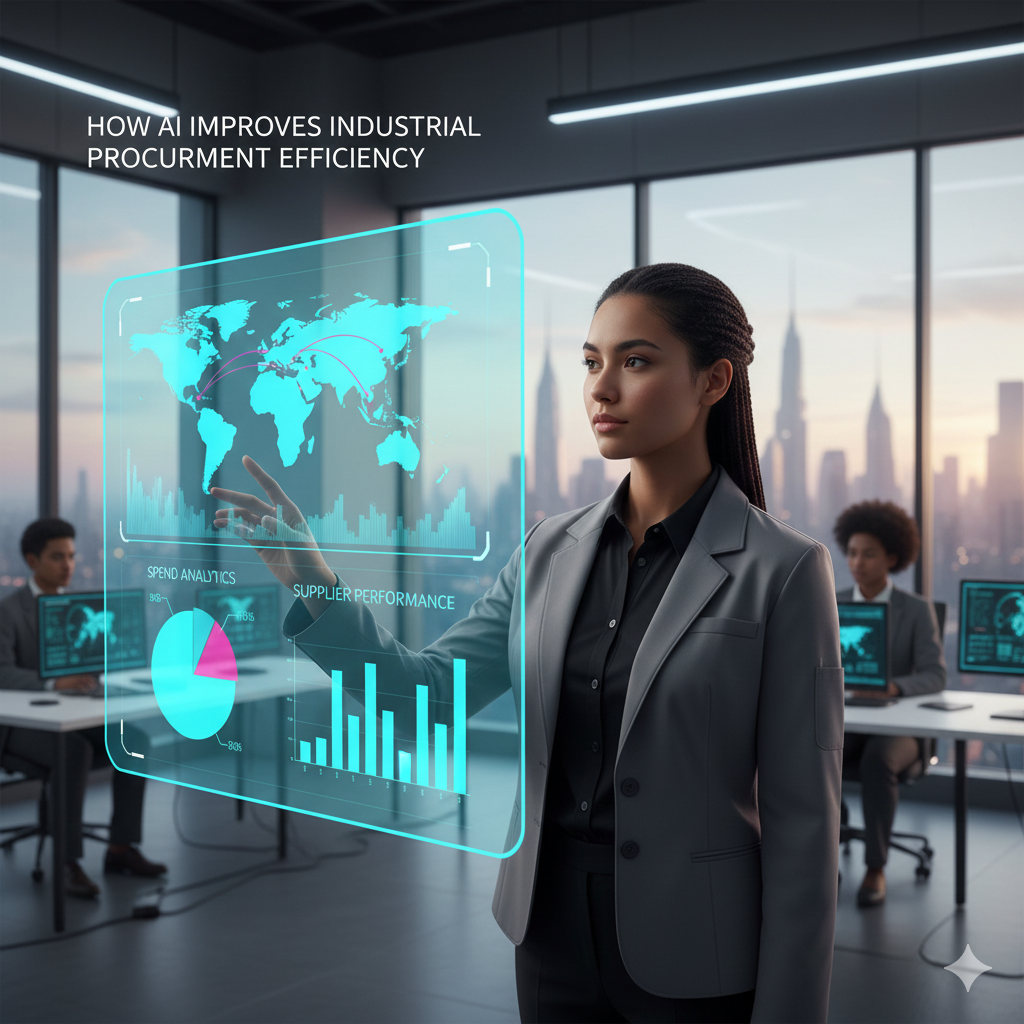
The analysis of purchasing patterns, supplier price, and market volatility can help uncover potential for cost savings through the use of artificial intelligence analytics. The use of predictive models can provide recommendations for alternative suppliers, techniques for bulk purchasing, or the ideal scheduling for orders in order to maintain cost efficiency. Artificial intelligence assists businesses in making educated financial decisions while preserving quality and reliability. This is accomplished by continuously monitoring spending and analyzing the effectiveness of utilization of procurement.
The management of risks and the monitoring of suppliers
Risks associated with industrial procurement include delays caused by suppliers, problems with quality, and disruptions caused by geopolitical events. Artificial intelligence systems continually monitor the performance of suppliers as well as external circumstances, thereby offering early warnings of potential problems. Machine learning algorithms have the ability to forecast the likelihood of disruptions and make recommendations for tactics to mitigate them. This provides procurement teams with the ability to take preventative actions and maintain a supply chain that is robust.
Improvements Made to Inventory Management
Through the optimization of stock levels based on production demand, lead times, and consumption patterns, artificial intelligence makes inventory management more effective. Predictive analytics ensure that commodities are available at the precise moment they are required, without tying up an excessive amount of cash in inventory. In addition to lowering storage costs, preventing material obsolescence, and providing support for just-in-time manufacturing processes, intelligent inventory control helps cut expenses.
Integration with ERP Systems and Industrial Internet of Things
Devices connected to the Industrial Internet of Things (IIoT) and Enterprise Resource Planning (ERP) systems can be easily integrated with procurement solutions that are powered by artificial intelligence. Real-time data on inventory levels, machine usage, and material consumption are provided by sensors connected to the Internet of Things (IoT), and artificial intelligence algorithms analyze this data to improve procurement decisions. Workflows that are cohesive, accurate reporting, and greater coordination between production and supply chain operations are all outcomes that can be achieved by integration.
Learning on an ongoing basis and working to improve processes
Artificial intelligence systems are always learning from data on procurement, the performance of suppliers, and trends in the market in order to modify recommendations over time. As fresh data becomes available, adaptive algorithms increase the accuracy of forecasts, the appraisal of suppliers, and the efficiency of procurement with more efficiency. In order to ensure that procurement strategies change in tandem with shifting market conditions and evolving industrial requirements, continuous learning is essential.
Providing Assistance with Strategic Decision-Making
Artificial intelligence brings about insights that help strategic procurement decisions, in addition to improving operational efficiency. There are long-term trends, patterns of supplier performance, and emerging market opportunities that can be uncovered through analytics. Utilizing these information, procurement teams can improve their ability to negotiate better contracts, diversify their supplier base, and align their procurement strategies with the broader aims of the organization.
By enabling intelligent supplier selection, predictive demand forecasting, automated workflows, cost optimization, and risk management, artificial intelligence greatly improves the efficiency of industrial procurement. Adaptive and data-driven procurement strategies are ensured by integration with Internet of Things (IoT) and enterprise resource planning (ERP) systems, as well as capabilities for continuous learning. Through the implementation of AI-driven solutions, industrial companies have the ability to streamline their operations, lower their costs, and establish a supply chain that is both resilient and efficient, thereby supporting their long-term growth and competitiveness.